 Add to Chrome
 Add to Firefox
 Add to Edge
JobBench: Aligning Agent Work With Human Will
May 25, 2026
Current benchmarks for occupational AI agents are scoped primarily by economic values, telling a replacement story. We introduce JobBench, which evaluates AI agents on the workflows that experts identify as high-priority for delegation, empowering humans based on their needs instead of replacing them with GDP value. JobBench covers 130 agentic tasks across 35 occupations. Each task is packaged as a workspace of heterogeneous reference files, requiring the agent to reason through the cluttered information streams of real professional work. Outputs are graded by a fact-anchored chain of rubrics, averaging 35.6 binary criteria per task. We evaluate 36 models; the strongest, Claude Opus~4.7 under Claude Code, reaches only 45.9 %. We hope JobBench shifts the community's target labour-market effect from replacement to enhancement: building agents that do what humans actually want delegated, not only what is most economically valuable.

On the limits and opportunities of AI reviewers: Reviewing the reviews of Nature-family papers with 45 expert scientists
May 20, 2026With the advancement of AI capabilities, AI reviewers are beginning to be deployed in scientific peer review, yet their capability and credibility remain in question: many scientists simply view them as probabilistic systems without the expertise to evaluate research, while other researchers are more optimistic about their readiness without concrete evidence. Understanding what AI reviewers do well, where they fall short, and what challenges remain is essential. However, existing evaluations of AI reviewers have focused on whether their verdicts match human verdicts (e.g., score alignment, acceptance prediction), which is insufficient to characterize their capabilities and limits. In this paper, we close this gap through a large-scale expert annotation study, in which 45 domain scientists in Physical, Biological, and Health Sciences spent 469 hours rating 2,960 individual criticisms (each targeting one specific aspect of a paper) from human-written and AI-generated reviews of 82 Nature-family papers on correctness, significance, and sufficiency of evidence. On a composite of all three dimensions, a reviewing agent powered by GPT-5.2 scores above each paper's top-rated human reviewer (60.0% vs. 48.2%, p = 0.009), while all three AI reviewers (including Gemini 3.0 Pro and Claude Opus 4.5) exceed the lowest-rated human across every dimension. AI reviewers' accurate criticisms are also more often rated significant and well-evidenced, and surface a distinct 26% of issues no human raises. However, AI reviewers overlap far more than humans do (21% vs. 3% for cross-reviewer pairs), and exhibit 16 recurring weaknesses humans do not share, such as limited subfield knowledge, lack of long context management over multiple files, and overly critical stance on minor issues. Overall, our results position current AI reviewers as complements to, not substitutes for, human reviewers.
On the Interplay of Pre-Training, Mid-Training, and RL on Reasoning Language Models
Dec 08, 2025Recent reinforcement learning (RL) techniques have yielded impressive reasoning improvements in language models, yet it remains unclear whether post-training truly extends a model's reasoning ability beyond what it acquires during pre-training. A central challenge is the lack of control in modern training pipelines: large-scale pre-training corpora are opaque, mid-training is often underexamined, and RL objectives interact with unknown prior knowledge in complex ways. To resolve this ambiguity, we develop a fully controlled experimental framework that isolates the causal contributions of pre-training, mid-training, and RL-based post-training. Our approach employs synthetic reasoning tasks with explicit atomic operations, parseable step-by-step reasoning traces, and systematic manipulation of training distributions. We evaluate models along two axes: extrapolative generalization to more complex compositions and contextual generalization across surface contexts. Using this framework, we reconcile competing views on RL's effectiveness. We show that: 1) RL produces true capability gains (pass@128) only when pre-training leaves sufficient headroom and when RL data target the model's edge of competence, tasks at the boundary that are difficult but not yet out of reach. 2) Contextual generalization requires minimal yet sufficient pre-training exposure, after which RL can reliably transfer. 3) Mid-training significantly enhances performance under fixed compute compared with RL only, demonstrating its central but underexplored role in training pipelines. 4) Process-level rewards reduce reward hacking and improve reasoning fidelity. Together, these results clarify the interplay between pre-training, mid-training, and RL, offering a foundation for understanding and improving reasoning LM training strategies.
The Tool Decathlon: Benchmarking Language Agents for Diverse, Realistic, and Long-Horizon Task Execution
Oct 29, 2025Real-world language agents must handle complex, multi-step workflows across diverse Apps. For instance, an agent may manage emails by coordinating with calendars and file systems, or monitor a production database to detect anomalies and generate reports following an operating manual. However, existing language agent benchmarks often focus on narrow domains or simplified tasks that lack the diversity, realism, and long-horizon complexity required to evaluate agents' real-world performance. To address this gap, we introduce the Tool Decathlon (dubbed as Toolathlon), a benchmark for language agents offering diverse Apps and tools, realistic environment setup, and reliable execution-based evaluation. Toolathlon spans 32 software applications and 604 tools, ranging from everyday platforms such as Google Calendar and Notion to professional ones like WooCommerce, Kubernetes, and BigQuery. Most of the tools are based on a high-quality set of Model Context Protocol (MCP) servers that we may have revised or implemented ourselves. Unlike prior works, which primarily ensure functional realism but offer limited environment state diversity, we provide realistic initial environment states from real software, such as Canvas courses with dozens of students or real financial spreadsheets. This benchmark includes 108 manually sourced or crafted tasks in total, requiring interacting with multiple Apps over around 20 turns on average to complete. Each task is strictly verifiable through dedicated evaluation scripts. Comprehensive evaluation of SOTA models highlights their significant shortcomings: the best-performing model, Claude-4.5-Sonnet, achieves only a 38.6% success rate with 20.2 tool calling turns on average, while the top open-weights model DeepSeek-V3.2-Exp reaches 20.1%. We expect Toolathlon to drive the development of more capable language agents for real-world, long-horizon task execution.
VisCoder: Fine-Tuning LLMs for Executable Python Visualization Code Generation
Jun 04, 2025Large language models (LLMs) often struggle with visualization tasks like plotting diagrams, charts, where success depends on both code correctness and visual semantics. Existing instruction-tuning datasets lack execution-grounded supervision and offer limited support for iterative code correction, resulting in fragile and unreliable plot generation. We present VisCode-200K, a large-scale instruction tuning dataset for Python-based visualization and self-correction. It contains over 200K examples from two sources: (1) validated plotting code from open-source repositories, paired with natural language instructions and rendered plots; and (2) 45K multi-turn correction dialogues from Code-Feedback, enabling models to revise faulty code using runtime feedback. We fine-tune Qwen2.5-Coder-Instruct on VisCode-200K to create VisCoder, and evaluate it on PandasPlotBench. VisCoder significantly outperforms strong open-source baselines and approaches the performance of proprietary models like GPT-4o-mini. We further adopt a self-debug evaluation protocol to assess iterative repair, demonstrating the benefits of feedback-driven learning for executable, visually accurate code generation.
Temporal Sampling for Forgotten Reasoning in LLMs
May 26, 2025Fine-tuning large language models (LLMs) is intended to improve their reasoning capabilities, yet we uncover a counterintuitive effect: models often forget how to solve problems they previously answered correctly during training. We term this phenomenon temporal forgetting and show that it is widespread across model sizes, fine-tuning methods (both Reinforcement Learning and Supervised Fine-Tuning), and multiple reasoning benchmarks. To address this gap, we introduce Temporal Sampling, a simple decoding strategy that draws outputs from multiple checkpoints along the training trajectory. This approach recovers forgotten solutions without retraining or ensembling, and leads to substantial improvements in reasoning performance, gains from 4 to 19 points in Pass@k and consistent gains in Majority@k across several benchmarks. We further extend our method to LoRA-adapted models, demonstrating that storing only adapter weights across checkpoints achieves similar benefits with minimal storage cost. By leveraging the temporal diversity inherent in training, Temporal Sampling offers a practical, compute-efficient way to surface hidden reasoning ability and rethink how we evaluate LLMs.
Unlearning Isn't Deletion: Investigating Reversibility of Machine Unlearning in LLMs
May 22, 2025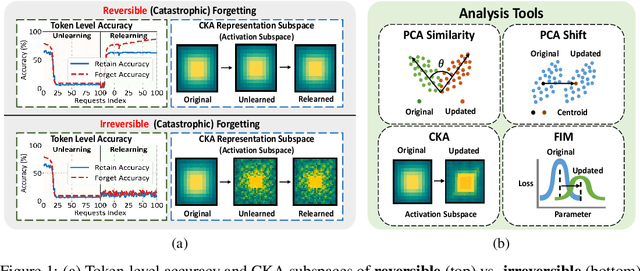
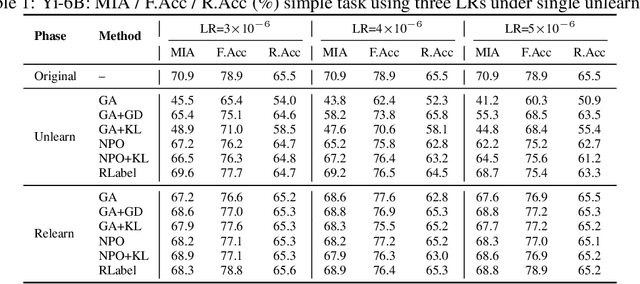
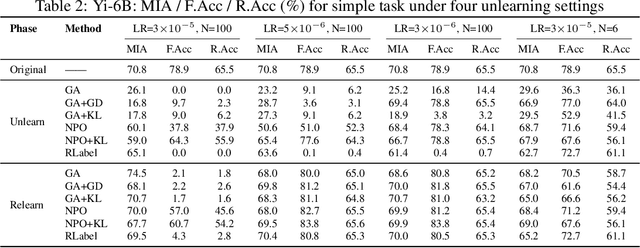
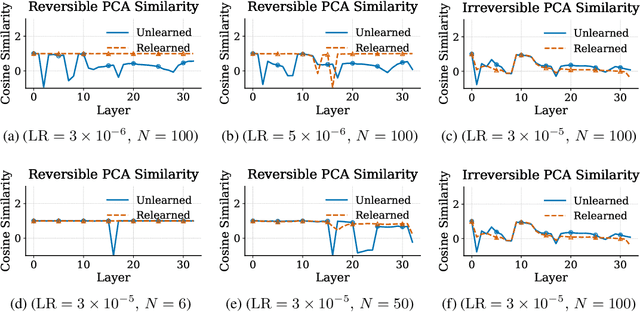
Unlearning in large language models (LLMs) is intended to remove the influence of specific data, yet current evaluations rely heavily on token-level metrics such as accuracy and perplexity. We show that these metrics can be misleading: models often appear to forget, but their original behavior can be rapidly restored with minimal fine-tuning, revealing that unlearning may obscure information rather than erase it. To diagnose this phenomenon, we introduce a representation-level evaluation framework using PCA-based similarity and shift, centered kernel alignment, and Fisher information. Applying this toolkit across six unlearning methods, three domains (text, code, math), and two open-source LLMs, we uncover a critical distinction between reversible and irreversible forgetting. In reversible cases, models suffer token-level collapse yet retain latent features; in irreversible cases, deeper representational damage occurs. We further provide a theoretical account linking shallow weight perturbations near output layers to misleading unlearning signals, and show that reversibility is modulated by task type and hyperparameters. Our findings reveal a fundamental gap in current evaluation practices and establish a new diagnostic foundation for trustworthy unlearning in LLMs. We provide a unified toolkit for analyzing LLM representation changes under unlearning and relearning: https://github.com/XiaoyuXU1/Representational_Analysis_Tools.git.
The CoT Encyclopedia: Analyzing, Predicting, and Controlling how a Reasoning Model will Think
May 15, 2025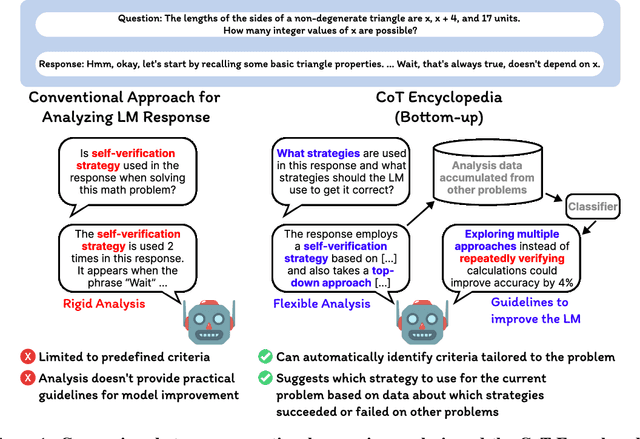
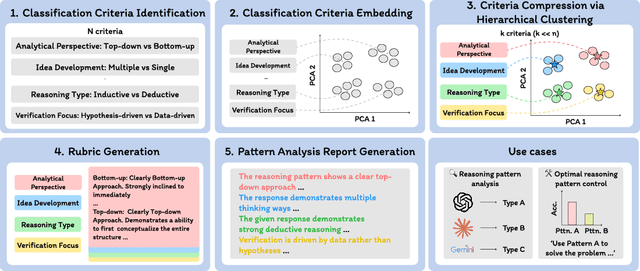
Long chain-of-thought (CoT) is an essential ingredient in effective usage of modern large language models, but our understanding of the reasoning strategies underlying these capabilities remains limited. While some prior works have attempted to categorize CoTs using predefined strategy types, such approaches are constrained by human intuition and fail to capture the full diversity of model behaviors. In this work, we introduce the CoT Encyclopedia, a bottom-up framework for analyzing and steering model reasoning. Our method automatically extracts diverse reasoning criteria from model-generated CoTs, embeds them into a semantic space, clusters them into representative categories, and derives contrastive rubrics to interpret reasoning behavior. Human evaluations show that this framework produces more interpretable and comprehensive analyses than existing methods. Moreover, we demonstrate that this understanding enables performance gains: we can predict which strategy a model is likely to use and guide it toward more effective alternatives. Finally, we provide practical insights, such as that training data format (e.g., free-form vs. multiple-choice) has a far greater impact on reasoning behavior than data domain, underscoring the importance of format-aware model design.
VisualPuzzles: Decoupling Multimodal Reasoning Evaluation from Domain Knowledge
Apr 15, 2025Current multimodal benchmarks often conflate reasoning with domain-specific knowledge, making it difficult to isolate and evaluate general reasoning abilities in non-expert settings. To address this, we introduce VisualPuzzles, a benchmark that targets visual reasoning while deliberately minimizing reliance on specialized knowledge. VisualPuzzles consists of diverse questions spanning five categories: algorithmic, analogical, deductive, inductive, and spatial reasoning. One major source of our questions is manually translated logical reasoning questions from the Chinese Civil Service Examination. Experiments show that VisualPuzzles requires significantly less intensive domain-specific knowledge and more complex reasoning compared to benchmarks like MMMU, enabling us to better evaluate genuine multimodal reasoning. Evaluations show that state-of-the-art multimodal large language models consistently lag behind human performance on VisualPuzzles, and that strong performance on knowledge-intensive benchmarks does not necessarily translate to success on reasoning-focused, knowledge-light tasks. Additionally, reasoning enhancements such as scaling up inference compute (with "thinking" modes) yield inconsistent gains across models and task types, and we observe no clear correlation between model size and performance. We also found that models exhibit different reasoning and answering patterns on VisualPuzzles compared to benchmarks with heavier emphasis on knowledge. VisualPuzzles offers a clearer lens through which to evaluate reasoning capabilities beyond factual recall and domain knowledge.
Speculative Thinking: Enhancing Small-Model Reasoning with Large Model Guidance at Inference Time
Apr 12, 2025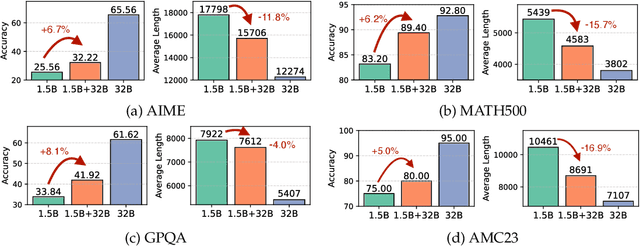
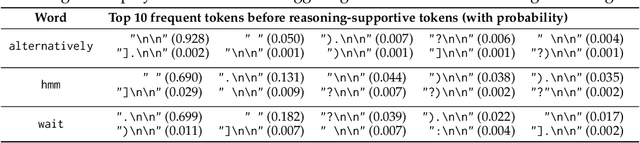
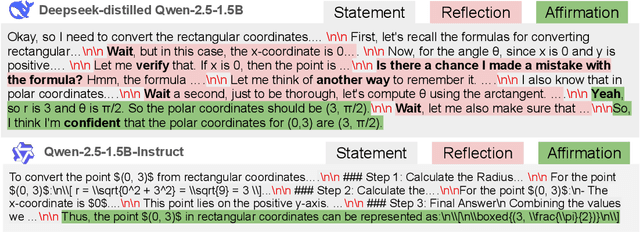
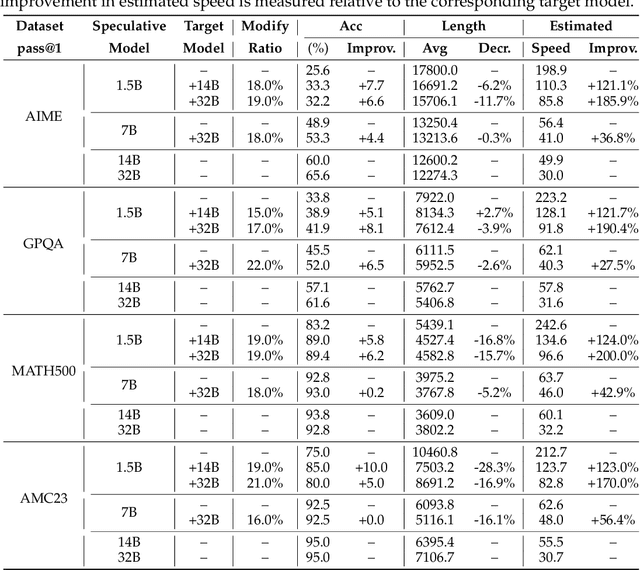
Recent advances leverage post-training to enhance model reasoning performance, which typically requires costly training pipelines and still suffers from inefficient, overly lengthy outputs. We introduce Speculative Thinking, a training-free framework that enables large reasoning models to guide smaller ones during inference at the reasoning level, distinct from speculative decoding, which operates at the token level. Our approach is based on two observations: (1) reasoning-supportive tokens such as "wait" frequently appear after structural delimiters like "\n\n", serving as signals for reflection or continuation; and (2) larger models exhibit stronger control over reflective behavior, reducing unnecessary backtracking while improving reasoning quality. By strategically delegating reflective steps to a more capable model, our method significantly boosts the reasoning accuracy of reasoning models while shortening their output. With the assistance of the 32B reasoning model, the 1.5B model's accuracy on MATH500 increases from 83.2% to 89.4%, marking a substantial improvement of 6.2%. Simultaneously, the average output length is reduced from 5439 tokens to 4583 tokens, representing a 15.7% decrease. Moreover, when applied to a non-reasoning model (Qwen-2.5-7B-Instruct), our framework boosts its accuracy from 74.0% to 81.8% on the same benchmark, achieving a relative improvement of 7.8%.